
1Late detection
Critical issues are often discovered by users first
Many teams don't have alerting that catches every production issue. Customer reports become the first signal - and by then, trust is already slipping.
in seconds.
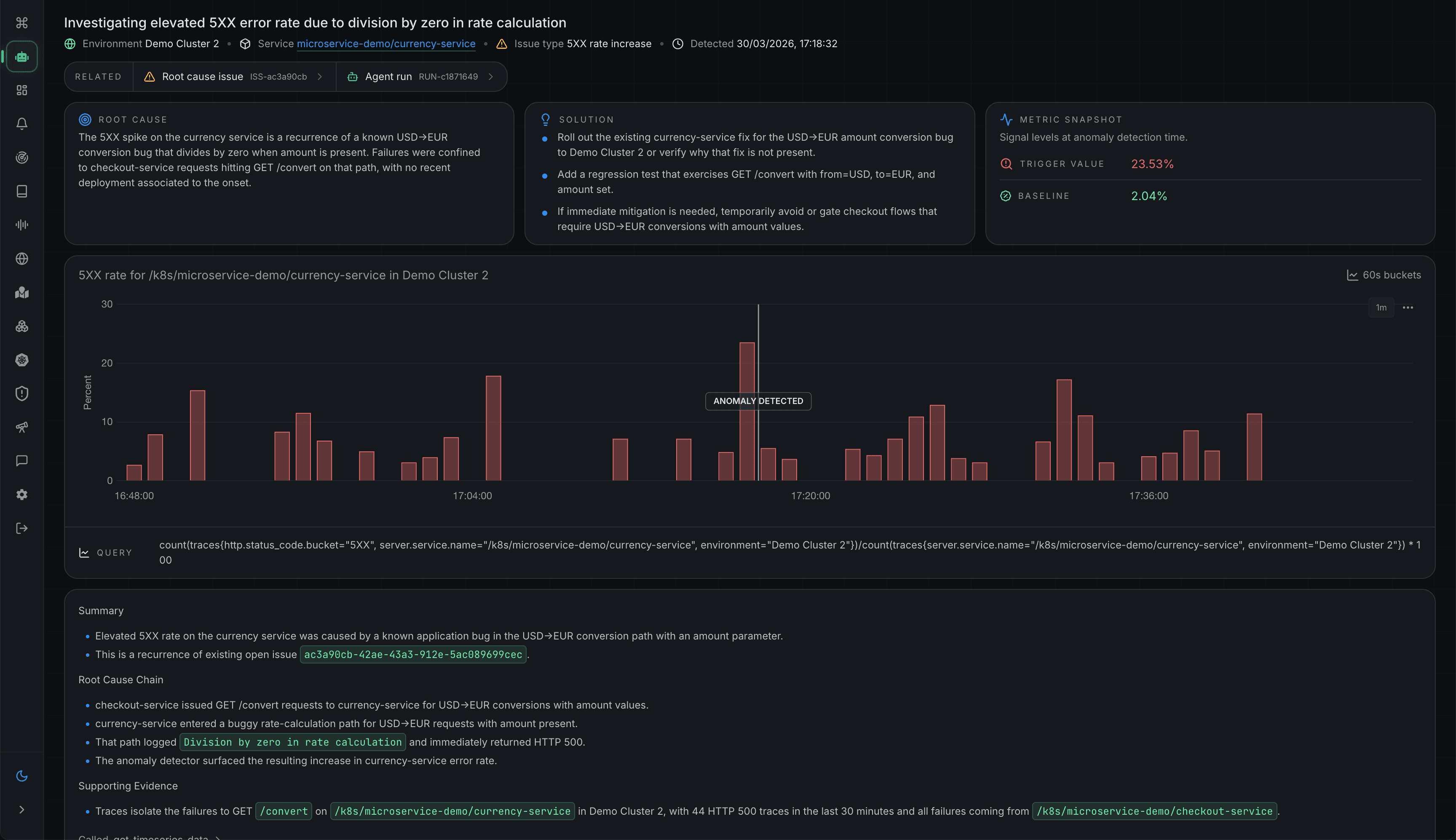
Metoro detects incidents from live traffic, investigates autonomously across code, infra, logs, and traces, and hands you a review-ready fix PR. No alerts to tune. No dashboards to search.
Free trial · No credit card · Deploy in under a minute












Teams learn about failures after user impact, then spend hours isolating signal from noise.
Many teams don't have alerting that catches every production issue. Customer reports become the first signal - and by then, trust is already slipping.
Reliable alerts aren't instant. They're tuned over time, after pages, misses, and repeated postmortems. You pay for every iteration.
Most anomalies aren't severe, but engineers still spend time investigating each one to find the real problems hiding in the noise.
Always-on issue detection. Root cause analysis that runs itself. A pull request with the fix, ready for review - usually before the first engineer joins the war room.
Metoro spots behavior regressions from live cluster signals without predefined alerts. Anomalies get scored, noise stays in noise.
The AI correlates telemetry, deploy events, and code context to isolate why the incident happened - not just where.
Metoro proposes a targeted patch and raises a pull request with evidence your team can review, edit, and merge.
Metoro combines layered runtime and engineering context so investigation quality improves from signal to signal, not guess to guess.
Reads signals directly from the Linux kernel - per-call traces, logs, metrics - with no SDK, no sidecar, no instrumentation work.
Bring domain-specific signals through OTLP or Prometheus remote write endpoints to enrich the model.
Connect runtime failures to commits, owners, and recently shipped changes - so the AI can reason across the whole system.
Use incident memory to recognize recurring patterns and move to remediation faster.
Metoro has made visibility into our Kubernetes environment effortless with on-demand event analysis and AI-driven root-cause investigations. Nothing is hidden anymore.
Metoro absolutely slaps, so good ❤️
Detection, investigation, and the fix PR - all before I finished reading the page. It's the first AI SRE that's actually earned its name.
Metoro has been a huge boon to our observability ecosystem; saving us time and effort getting the information we care about most out of our clusters. The only thing cooler than the tool has been the people behind it.
It found exactly what I was looking for in the logs. Amazing.
We used to spend an hour digging through dashboards when something broke. Now Metoro figures it out in minutes - our on-call engineers love it.
We installed Metoro, and it just worked.
I'm literally able to look up at a Slack notification from Metoro whilst having noodles, tap the link, access the Metoro dashboard, see what customers on Porter Cloud are doing and take a call in real-time. For me, that's the best thing ever.
In the last week, we've detected and blocked 10 malicious agents running on our infrastructure. Without Metoro, they would still likely be running.
Metoro made it incredibly simple for us to not just observe and trace logs, but also to dive into AI-driven investigations effortlessly - turning complex Kubernetes monitoring into a smooth, intuitive experience.
Anyone running user agents on their infrastructure needs a solution like Metoro. It's just a case of when, not if a malicious agent will be running.
Everything about AI RCA.
Detection to remediation - automated. One-minute install. No code changes.